Why legal strategy matters even after a negative decision
In deportation cases, it may sometimes seem that nothing can be done after a negative decision.
The decision has been issued.
Deadlines are running.
The person faces removal.
The legal perspective appears almost closed.
But legal reality is more complex.
Sometimes a case is not finally lost. Sometimes it was simply not presented deeply enough.
Recently, I obtained the suspension of deportation in the case of a Russian citizen who had already received a removal decision from Switzerland.
The applicant’s name, personal details and case-specific identifying information are not disclosed. This is a matter of confidentiality, security and respect for a person in a vulnerable position.
The substance of the case
The case concerned a Russian citizen with serious health problems.
At the same time, the case file contained information about criminal proceedings in Russia connected with her personal beliefs and peaceful expression of position.
This was not an abstract reference to fear. The file contained documents indicating an individual risk, procedural actions in Russia and the likelihood that, upon return, she could face detention and further persecution.
In such cases, deportation is not an ordinary administrative act.
It may lead to irreversible consequences: detention, transfer to law enforcement authorities, ill-treatment, deterioration of health and the practical impossibility of obtaining effective protection.
Why the previous position was weak
One of the reasons for the negative decision was that the previous legal position did not disclose the case in full.
Formally, arguments had been submitted. But in substance, the connection between the medical condition, criminal proceedings, return risk and Switzerland’s international obligations had not been shown clearly enough.
In deportation cases involving Russia, it is not enough to simply state that a person is in danger.
It is necessary to show:
- individual risk;
- documentary basis;
- the link between persecution and the applicant’s personal situation;
- the risk of detention after return;
- the absence of a safe internal relocation alternative;
- medical vulnerability;
- the risk of violating Article 3 ECHR;
- the risk of violating the principle of non-refoulement.
This structure often determines the fate of a case.
The central legal question
In such cases, the central question is not whether a person wants to remain in Switzerland.
The real question is different:
Can Switzerland enforce deportation without violating Article 3 ECHR and the principle of non-refoulement?
If return creates a real risk of detention, ill-treatment, persecution or deterioration of health in circumstances where effective protection is unavailable, those circumstances must be assessed before deportation is enforced.
That is why the request for reconsideration was not built on emotion. It was built on a legal connection between new facts, individual risk, medical vulnerability, criminal proceedings in Russia, the risk of detention after return and the prohibition of removal where treatment incompatible with Article 3 ECHR may occur.
What was done
After reviewing the materials, it became clear that the case required a new legal construction.
Previous decisions, evidence, procedural history, medical circumstances, information about risk in Russia and weaknesses in the earlier legal position were analysed.
The request for reconsideration was not based on general disagreement with the decision. It was based on new substantial facts, documents and an individual risk assessment. The core elements were medical vulnerability, criminal proceedings in Russia, the risk of detention after return and the possible violation of Article 3 ECHR and the principle of non-refoulement.
The key task was to show that deportation in this case could lead not merely to return to the country of origin, but to a real and individual risk to the person’s liberty, health and safety.
A qualified request for reconsideration was prepared and submitted on the basis of new substantial facts and evidence. The request asked for the previous decisions to be reassessed, for the new circumstances to be examined and for removal to be considered impermissible where it could breach Switzerland’s international obligations.
The result
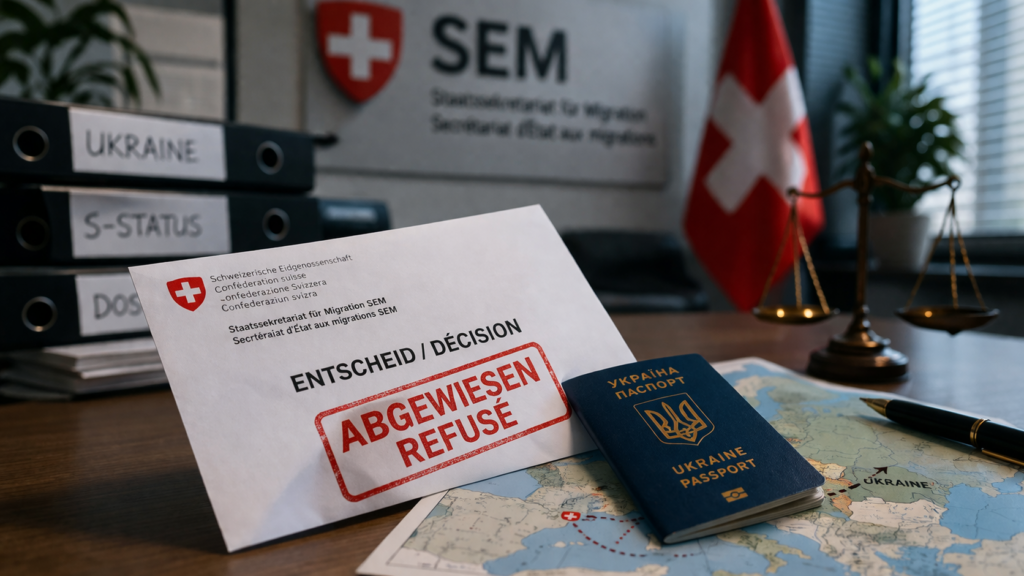
Two weeks after the request was submitted, SEM sent a letter to the cantonal migration authority, with a copy to me.
In connection with the reconsideration of the case, the deportation was suspended.
That was the key result.
The case returned to the legal field.
Enforcement of removal was stopped.
A new assessment of the facts, evidence and individual risk became possible.
Why this matters
This case demonstrates a simple point.
A negative decision does not always mean that a case is over.
But a request for reconsideration only makes sense when there is a real legal basis:
- new facts;
- new evidence;
- serious errors in the previous assessment;
- individual risk after return;
- medical vulnerability;
- risk of violating Article 3 ECHR;
- risk of violating the principle of non-refoulement.
Without this, a request for reconsideration becomes an empty document.
With it, such a request can become an instrument for protecting life, liberty and human dignity.
Personal conclusion
When I reviewed this case, I did not see just a file or an administrative procedure.
I saw a human fate.
Serious illness.
Criminal proceedings.
Risk of detention after return.
A weak previous legal position.
And an almost complete sense of hopelessness.
But it is precisely in such cases that legal strategy matters.
Law does not work when it is beautifully written on paper.
Law works when facts, evidence and risk are brought together into a precise legal structure.
In such cases, professional satisfaction does not come from the public visibility of the result. It comes from understanding that legal work has protected a person from irreversible consequences.
Everything may be relative. But law and justice — never.
With respect for the rule of law,
Luciano Shirvani
LLCA — Luciano Legal Consulting & Analytics
Postfach 3001
Bern, Switzerland
Website: https://llca.ch
Email: info@llca.ch