Asylum, Deportation, and Extradition in Switzerland
Asylum, deportation, and extradition cases in Switzerland are rarely straightforward. Behind every such case lies not only an administrative procedure but also a real risk to a person’s freedom, safety, and future.
A denial of asylum, a departure order, the threat of forced deportation, an international arrest warrant, or an extradition request can change a person’s life in a matter of days. In such situations, simply filing paperwork is not enough. What is needed is a precise legal strategy based on facts, deadlines, evidence, and a proper risk assessment.

Many people seek help too late. Often, they have already received a negative decision, missed an important procedural step, or are facing the threat of forced removal from Switzerland. But even in complex cases, the outcome depends not only on what happened. It depends on how competently it was explained from a legal standpoint.
People searching for an asylum consultant in Bern or an experienced jurist in asylum matters often need more than a general legal opinion. They need a strategic assessment of their asylum file, deportation risk, possible extradition exposure, Interpol-related risks and available international protection options.
LLCA provides asylum legal support in Switzerland for complex cases where asylum, deportation, extradition, Interpol-related risks and human rights protection intersect. For clients who need structured legal analysis in Bern, the first step is a detailed review of documents, facts, deadlines, procedural history and legal risks.
My name is Luciano. I am an international jurist with 25 years of experience in international law, human rights, migration procedures, and transnational legal protection. My professional experience involves cases where asylum, deportation, extradition, Interpol, the European Court of Human Rights, the International Criminal Court, and international protection mechanisms intersect.
At Luciano Legal Consulting & Analytics in Bern, we handle cases where a standard approach is insufficient. Such cases require not a cookie-cutter consultation, but a cold analysis, legal discipline, and a precise defense strategy.
Asylum in Switzerland: Not a Form, but a Legal Framework
The asylum procedure in Switzerland is not merely a matter of filling out a form. The individual must explain why they need international protection and why returning to their country of origin poses a real risk to them.
The State Secretariat for Migration assesses whether the grounds for asylum are credible and whether the applicant meets the requirements for refugee status under the Swiss Asylum Act. If the decision is negative, a departure order from Switzerland is typically issued. At the same time, the authorities must consider whether the removal is permissible, feasible, and reasonable. (sem.admin.ch)
The main mistake many applicants make is thinking that simply expressing fear is enough. That is not enough. In the Swiss system, fear must be translated into legal terms.
Not simply: “It is dangerous for me to return.”
But legally: why is this particular person at risk of persecution, torture, arbitrary detention, political reprisals, inhuman treatment, or a violation of the principle of non-refoulement?
This is precisely where many cases fall short. Not because the person does not face a real risk, but because that risk has not been properly explained, substantiated, and legally linked to the applicable legal standards.
A denial of asylum does not always mean the end of the case
A negative decision by the SEM does not always mean that everything is over. Depending on the type of procedure and the content of the decision, an appeal to the Federal Administrative Court may be possible. In the extended procedure, rejected applicants have 30 days to appeal the decision. In other procedures, the deadlines may be significantly shorter. (sem.admin.ch)
After a rejection, there is no time to waste. You must immediately check what procedural options are still available, what errors the authority made, and what evidence can be submitted.
The key questions are usually as follows:
Did the SEM correctly assess the applicant’s personal risk?
Were political, ethnic, religious, social, or family circumstances taken into account?
Were medical or psychological factors ignored?
Was up-to-date information about the country of origin used?
Are there contradictions in the SEM’s decision?
Can new evidence be submitted?
Is an appeal, review, or other urgent procedural measure possible?
Does deportation violate Switzerland’s international obligations?
In asylum cases, structure matters more than emotion. The facts must be organized. Documents must be linked to legal arguments. The risk must be individualized. The narrative must be legally coherent.
A weak presentation can ruin a strong case
Deportation from Switzerland: An Administrative Decision with Human Consequences
For the state, deportation may appear to be the enforcement of an administrative decision. For the individual, it may mean a return to prison, torture, political persecution, blood feuds, or threats from intelligence agencies, paramilitary groups, criminal organizations, or one’s family circle.
Therefore, deportation cases cannot be approached in a purely technical manner.
The Swiss system distinguishes between asylum rejection, a departure order, the enforcement of removal, temporary admission, and other legal consequences. If return is impossible, inadmissible, or unreasonable, the question of temporary admission may arise. Official SEM statistics explicitly state that temporary admission applies, in particular, when removal is not permitted due to a specific threat or a violation of the European Convention on Human Rights, when return is unreasonable due to war or serious personal circumstances, or when return is impossible. (sem.admin.ch)
Each case requires a separate analysis:
On what grounds was the removal decision issued?
Which authority is responsible for enforcing the removal?
Is there a risk of forced deportation?
Can enforcement be stopped?
Are there new circumstances?
Are there medical, family, or humanitarian grounds?
Is there a risk of violating the European Convention on Human Rights?
Can urgent legal mechanisms be used?
In some cases, deportation already seems inevitable. But it is precisely at this stage that the outcome is often decided not by a formal dispute, but by the quality of the legal counterargument.
It is necessary to understand not only Swiss immigration law. It is necessary to understand how risk is assessed. How the authorities operate. How the evidence base is established. How an urgent appeal is filed. How to use documents, medical records, country-specific information, human rights materials, and individual circumstances.
A deportation case cannot be handled as routine correspondence with the administration. It is about protecting a person from forced return to a potentially dangerous environment.
Extradition: A Separate Legal Front
Extradition differs from deportation. Deportation is usually linked to an immigration or asylum process. Extradition involves a request from another state to hand over a person for criminal prosecution or to serve a sentence.
In Switzerland, extradition matters fall under the scope of international legal assistance in criminal cases. The Federal Office of Justice notes that extradition procedures are governed by the Federal Act on International Mutual Assistance in Criminal Matters. The Extradition Division reviews foreign requests related to the detention of a person pending extradition, and if the person objects, an extradition warrant may be issued. (bj.admin.ch)
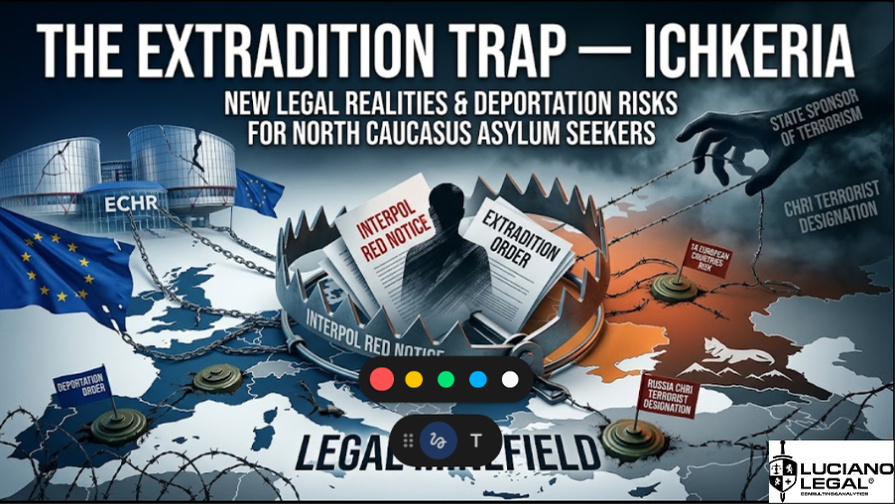
In practice, deportation and extradition often overlap. A person may seek asylum in Switzerland because they are facing political persecution. At the same time, their country of origin may submit an extradition request and claim that the case involves ordinary criminal proceedings.
This is where things get complicated
Formally, the documents may cite: fraud, extremism, terrorism, economic crime, violence, tax evasion, or abuse of office.
But the legal question runs deeper.
Is this a genuine criminal case or a tool of political pressure?
Authoritarian states often use criminal cases against opponents, journalists, businesspeople, activists, former officials, members of minority groups, and people who have become inconvenient.
On paper, this may look like criminal prosecution. In reality, it is political neutralization through international mechanisms.
Therefore, in extradition cases, the following must be examined:
Who initiated the criminal case.
When it was initiated.
What happened prior to the initiation of the case.
Whether there is a political, ethnic, religious, or personal motive.
How independent the judicial system of the requesting state is.
Whether there is a risk of torture or inhuman treatment.
What are the conditions of detention in prisons?
Can the person receive a fair trial?
Are there signs of a fabricated charge?
Is Interpol or an international arrest warrant being used as a tool of pressure?
An extradition case cannot be defended solely with citations from the law. The context must be examined.
When asylum and extradition proceed in parallel
The most dangerous cases are those where a person is simultaneously in the asylum process and under threat of extradition.
In such situations, the state of origin may argue: “He is not a political refugee. He is a criminal.”
The defense must demonstrate otherwise: the charges may be politically motivated, the criminal case may be a tool of persecution, extradition may lead to torture, an unfair trial, or unlawful detention, and extradition may effectively violate the principle of non-refoulement.
Here, the case cannot be split into two separate files.
Asylum file, extradition file, Interpol file, human rights file—all of this must be woven into a single strategy.
If the asylum defense argues one thing and the defense against extradition argues another, the case is weakened. If documents are submitted haphazardly, authorities gain the opportunity to exploit contradictions. If the political context is not explained, the criminal charge may appear convincing.
Therefore, a unified defense strategy is needed.
Interpol and international warrants
Many clients believe that if a person is wanted, the situation is hopeless.
This is incorrect.
The existence of an Interpol Red Notice or other international alert does not imply automatic guilt. It is not a conviction. It is a tool of international police cooperation that can be used lawfully, but can also be misused.
Especially in cases involving authoritarian states.
For the defense, it is important to establish:
On what grounds the person is wanted.
Which state initiated the request.
Is there a political motive?
Does the criminal prosecution coincide with a political conflict?
Is there a risk of abuse of international mechanisms?
Have there been previous threats, pressure, detentions, torture, or persecution?
How to link the Interpol risk to an asylum or extradition case.
In some cases, an international wanted notice is not evidence of criminality, but evidence of the danger of return.
Why many cases are lost
Most weak cases are lost not because the person is not at risk. They are lost because the risk is poorly explained.
Typical mistakes:
Too much emotion and too little structure.
Lack of chronology.
Contradictory statements.
Incorrect emphasis on secondary facts.
Weak evidence.
Late response to a decision.
Ignoring medical records.
Lack of country analysis.
Presenting facts in isolation without a unified strategy.
Attempting to explain a complex case in everyday language.
In immigration, deportation, and extradition cases, the government does not read the person’s story. The government reads the file.
If the file is weak, the person is weak in the eyes of the system. If the file is strong, even a difficult case gets a chance.
What Makes a Legal Strategy Strong
A strong strategy does not start with a letter. It starts with a diagnosis.
You need to understand:
What has already been filed.
What has already been said.
What deadlines are open.
What mistakes have been made.
What facts have been confirmed.
What facts can still be confirmed.
What documents are missing.
What arguments the SEM or another agency has already used.
Where the weak point in the decision lies.
What legal mechanisms are actually available now.
After that, the defense strategy is built.
You cannot write a complaint first and then think about strategy. You cannot submit chaotic letters to various authorities without understanding the consequences. You cannot overload the case with information that does not help legally.
Good defense is about precision.
Who needs urgent legal assistance
Legal assistance is needed immediately if:
Asylum has been denied.
A deadline for leaving Switzerland has been set.
There is a threat of forced deportation.
The person is in detention pending deportation.
There is a risk of return to a country where torture, imprisonment, persecution, or retaliation are possible.
An extradition request has been filed.
You have been detained due to an international arrest warrant.
There is an Interpol Red Notice or another international alert.
A criminal case in your country of origin is politically motivated.
There is a risk of family separation.
You have a serious medical or psychological condition.
Authorities are ignoring new circumstances.
In such situations, time is part of the defense. The sooner work begins, the more procedural options remain.
Why Luciano Legal Consulting & Analytics
Luciano Legal Consulting & Analytics is based in Bern and handles complex cases in the areas of asylum, deportation, extradition, international warrants, and human rights protection.
We do not treat such cases as standard immigration services.
In cases where a person faces deportation, extradition, or persecution, it is not enough to simply know the procedure. One must be able to connect the law, the facts, country-specific risks, the international context, and the individual’s personal history.
One must see not only the document but also the mechanism behind it.
In some cases, it is important to prove not only that the person fears returning. It is important to prove that the fear has legal significance, that the risk is real, that the charges may be politically motivated, that the country of origin does not guarantee a fair trial, and that extradition or deportation would create an unacceptable risk.
This requires a rigorous, precise, and disciplined strategy.
A difficult case is not always hopeless
Many people come for help only after being denied.
Some have received a negative SEM decision. Some missed an important step. Some are already facing deportation. Some have been detained. Some have been placed on an international wanted list. Some believe their case is already lost.
But in law, it’s not just the question of “what happened?” that matters.
Another question is crucial: Have all legal avenues truly been exhausted?
Were all documents submitted? Was the risk properly explained? Was the political context demonstrated? Were errors by the authorities identified? Were new circumstances utilized? Were international safeguards observed?
Sometimes a case seems closed simply because it was structured incorrectly.
Conclusion
Asylum, deportation, and extradition in Switzerland are not merely administrative procedures.
They are legal processes where a mistake can lead to irreversible consequences.
Behind every decision is a person. Behind every rejection is a risk. Behind every departure order lies a potential danger. Behind every extradition request lies the question of whether the case is truly criminal or politically motivated.
If you or a loved one faces a denial of asylum, deportation, extradition, or an international arrest warrant, the case must be assessed immediately.
Luciano Legal Consulting & Analytics
Bern, Switzerland
Asylum, Deportation, Extradition & Human Rights Protection
info@llca.ch
+41 77 979 45 59
Migration Law Switzerland
Refugee Protection
LLCA Bern