Deportation to Russia: Internal Relocation Alternative as a Legal Fiction in Cases Involving Chechen Applicants
Introduction
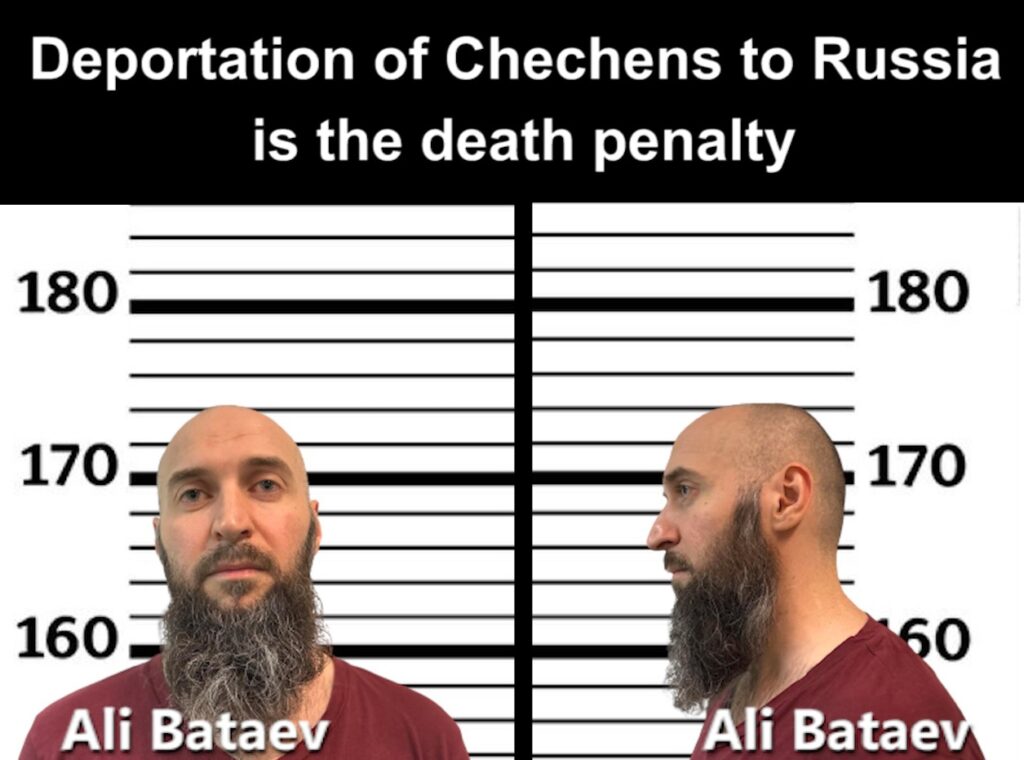
Deportation to Russia is a critical legal issue in cases involving Chechen applicants.
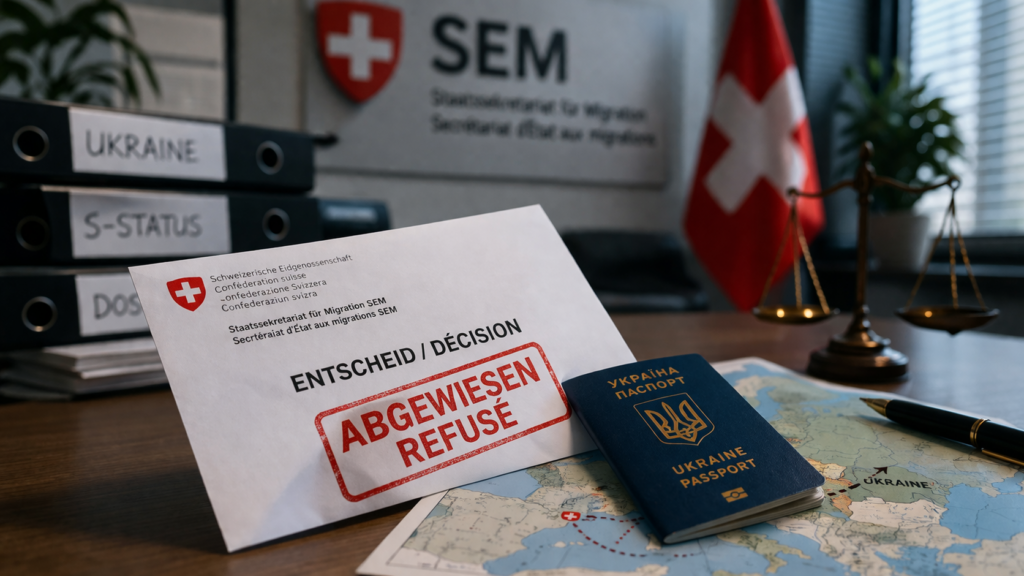
Switzerland has historically positioned itself as a state of the rule of law, humanitarian tradition, direct democracy, and international obligations. By signing the 1951 Refugee Convention and ratifying it at the level of national legislation, Switzerland undertook the obligation not to return a person to a place where they face torture, persecution, arbitrary deprivation of liberty, or inhuman treatment.
This principle is enshrined not only in international law, but also in the very legal philosophy of the state. It lies at the foundation of trust in the system.
However, in cases concerning deportation to the Russian Federation, a systemic conflict arises between this legal model and actual administrative practice. Formally, migration authorities may refer to the possibility of relocation to “another region of Russia.” In reality, such an argument ignores the actual structure of power, the specificity of the North Caucasus, the clan system, informal mechanisms of control, and the ability of Chechen security structures to operate far beyond Chechnya.
The key question in such cases is not whether another region exists on the map.
The key question is whether that region provides real, effective, and durable protection.
Internal Relocation Alternative: The Legal Standard and Its Distortion
For deportation to Russia Chechen applicants, internal relocation is not a safe alternative.
The concept of an internal relocation alternative is not a formal procedural possibility. It is a strict legal test.
For it to be applied, several conditions must be met simultaneously:
- real accessibility of relocation;
- safety in the place of intended residence;
- absence of a risk of persecution;
- availability of effective state protection;
- reasonableness of such relocation, taking into account the applicant’s specific situation.
If even one of these conditions is not met, the internal relocation alternative cannot be considered permissible.
In cases involving persons of Chechen origin who are in conflict with Chechen security structures, these conditions are systematically not met.
The internal relocation alternative within the Russian Federation in such cases is not a mechanism of protection. It may become a mechanism for subsequent identification, transfer of information, and forced return under the control of the Chechen authorities.
In these cases, the Russian Federation must be assessed not as a set of independent regions, but as a single space of coercion.
Chechnya: The Factual Reality Ignored in Administrative Decisions
The Chechen Republic is a territory of approximately 18,000 square kilometres. Within such a space, social, clan, family, and security ties function as a single system.
The question of safety in such a context cannot be assessed through abstract geography.
For a person who is in the focus of Chechen security structures, relocation within Russia does not eliminate the risk. It only changes the point of possible detection.
The argument of relocation to another region of Russia is untenable because it does not take into account:
- the clan structure of Chechen society;
- family and kinship ties;
- informal channels for the transfer of information;
- the influence of security structures beyond Chechnya;
- the practice of forced return of persons to Chechnya;
- the dependence of federal mechanisms on political will;
- the factual impossibility of hiding within a single administrative space.
Thus, the internal relocation alternative in these cases is not protection. It is a legal fiction.
The Case of Zarema Musayeva: Destroying the Argument of a “Safe Region”
The case of Zarema Musayeva is a key empirical example.
She lived in the Nizhny Novgorod region, that is, outside Chechnya. Despite this, Chechen security structures arrived in another region of the Russian Federation, detained her, and forcibly transferred her to Grozny.
The legal significance of this case is fundamental:
Being outside Chechnya did not provide any protection.
The federal mechanisms of the Russian Federation did not prevent the actions of Chechen security structures.
Regional borders did not become a barrier to persecution.
This case destroys the basic argument that a person who is in conflict with the Chechen authorities can safely relocate to another region of Russia.
If a person can be found, detained, and forcibly transferred over a distance of thousands of kilometres, the internal relocation alternative cannot be considered real protection.
The Transnational Nature of Risk: Aishat Baimuradova and Aliya Ozdamirova
The risk for persons of Chechen origin is not limited to the territory of the Russian Federation. Even departure from Russia does not always eliminate the threat if family, clan, security, or informal networks of search, pressure, and coercion are operating.
The case of Aishat Baimuradova in Armenia demonstrates precisely this. Aishat Baimuradova, a 23-year-old Chechen woman who had fled Chechnya, disappeared in Yerevan after meeting a woman whom she had met through social media. A few days later, her body was found in a rented apartment. Armenian law enforcement authorities identified the suspects as Karina Iminova and Said-Khamzat Baisarov, Russian citizens; later, they were placed on a wanted list.
The legal significance of this case lies in the fact that even Armenia, located outside the Russian Federation, did not become an effective zone of safety for her. If a person can be found, lured to a meeting, then disappear and be found dead, the risk cannot be considered local or limited to the territory of Chechnya.
The case of Aliya Ozdamirova in Georgia confirms the same mechanism. Aliya Ozdamirova, a 33-year-old Chechen woman, fled to Georgia because of threats. According to human rights defenders and media reports, she was deceived or forcibly taken back to Chechnya on 9 November 2025. Already on 12 November, she was buried in Chechnya; human rights defenders linked her death to a possible “honour killing.”
The legal significance of this case is that Georgia also did not provide factual protection. If a person, already being outside Russia, can be returned to Chechnya outside normal procedure and die shortly thereafter, then formal departure from Russia does not eliminate the risk of persecution.
These two cases show the following:
- persecution may have a transnational character;
- family, clan, and security networks may operate beyond the Russian Federation;
- deception, pressure, abduction, or forced return are possible;
- neighbouring states are not always able to provide effective protection;
- the risk is not geographically localised and is not limited to the territory of Chechnya or Russia;
- a formal border does not always mean real safety.
Therefore, the assessment of risk cannot be limited to territorial borders. For Chechen applicants under threat, the question should not be framed as: “Is the person outside Chechnya?” The correct question is: “Are the persecuting structures or networks connected to them capable of finding, luring, returning, or destroying this person?”
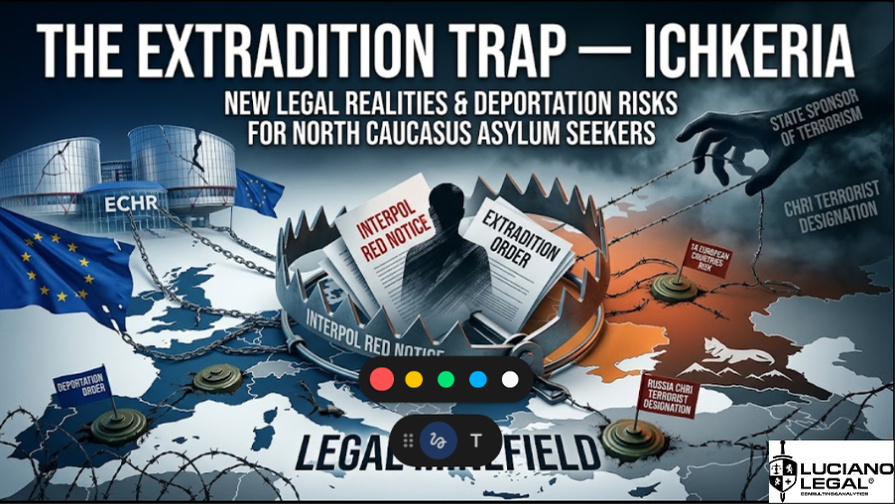
This conclusion directly undermines the argument that either an internal or external protection alternative exists.International Reports and Their Ignoring
Deportation to Russia raises serious non-refoulement concerns for Chechen applicants.
The claim that the human rights situation in the Russian Federation has improved requires serious and independent confirmation.
Such confirmation is absent.
On the contrary, reports by international organisations document the opposite dynamic:
— systematic use of torture;
— strengthening of repressive mechanisms;
— criminal prosecution as an instrument of pressure;
— absence of effective judicial protection.
In January 2024, Amnesty International directly called on European states to halt deportations of persons from the North Caucasus to Russia, pointing to the risk of torture, ill-treatment, arbitrary detention, enforced disappearances, and forced involvement in military action.
Thus, the administrative position on the permissibility of return to Russia enters into direct conflict with international sources.
Selective Use of Evidence
The problem in these cases lies not only in the assessment of facts, but also in the mechanism of decision-making.
As shown in analytical research, the underlying issue is the selective use of evidence.
In practice:
— some groups receive protection on the basis of the general context;
— others are required to prove individual risk even in the presence of international reports.
This means that it is not the evidence that determines the decision, but the preliminary classification of the applicant that determines which evidence will be recognised as sufficient.
Thus, this is not evidence-based policymaking, but evidence-selective policymaking.
Double Standards in the Assessment of Protection
A system of double standards is formed in migration practice:
- for some groups, there is a presumption of vulnerability;
- for others, there is a presumption of suspicion;
- for some, the general context is sufficient;
- for others, even international reports are considered insufficient.
For Chechen applicants, this means an increased risk of refusal despite the existence of an objective threat.
The Sheikh Mansur Battalion and the Problem of Russian Narratives
In some cases, official structures in European states appear to approach Chechen applicants through narratives shaped by Russian political framing.
In particular, in certain internal assessments, the Sheikh Mansur Battalion may be described as a terrorist or radical Islamist organisation. For reasons of confidentiality, the source of such classifications cannot be publicly disclosed.
This practice raises serious legal and moral questions.
Since 2014, the Sheikh Mansur Battalion has participated in the armed confrontation on the side of Ukraine against Russian aggression. Ignoring this fact while applying stigmatising qualifications without individual analysis reflects not a legal assessment, but the transfer of a Russian political narrative into migration practice.
Relying on the narratives of a state that has been recognised by the European Parliament as a state sponsor of terrorism and as a state using terrorist methods, when assessing Chechen applicants, means reproducing the position of a potential source of persecution.
Such logic is unacceptable. It replaces independent legal assessment with a borrowed political narrative and calls into question the objectivity of the procedure.
In international protection cases, risk assessment cannot be based on the positions of the state from which the applicant seeks protection. This contradicts the principle of non-refoulement, the principle of individual assessment, and the basic standards of international law.
The use of such narratives in migration procedures:
- distorts the factual assessment of risk;
- undermines the principle of individual analysis;
- creates a presumption of suspicion against Chechen applicants;
- reproduces the stigmatising logic of a potential persecutor;
- contradicts the principle of non-refoulement;
- undermines the basic standards of international protection.
If a state authority considers participation in or connection with a Chechen volunteer formation to be a risk or suspicion factor, it must conduct an individual, evidence-based, and independent assessment. Generalised qualifications based on Russian narratives cannot replace legal analysis.
In international protection cases, Chechen applicants must not be assessed through the political language of the state from which they seek protection.
Superficial Understanding of Russia as a Systemic Error
A serious problem is the superficial understanding of the Russian system.
Knowledge of the language is not equal to understanding the state.
Russian reality includes:
— informal networks of influence;
— the security vertical;
— dependence of the courts;
— the use of criminal prosecution;
— pressure through relatives;
— clan mechanisms.
Without understanding these factors, it is impossible to objectively assess risk.
Migration authorities must involve specialists who possess such knowledge.
Without this, the assessment of risk remains incomplete.
The Irony of History: The Caucasian Tradition of Asylum
The right to asylum was enshrined in the 1951 Convention. However, the very idea of protecting a persecuted person existed long before that.
During the period of serfdom in the Russian Empire, runaway peasants, serfs, and dependent people fled to the Caucasus.
The peoples of the Caucasus, including Chechens, received them, provided land, included them in the community, and protected them as their own.
In the event of attempts to return them, protection could reach the point of armed confrontation.
Asylum was not a formality, but a practice.
The irony lies in the fact that today representatives of these peoples themselves are forced to prove their right to protection.
The Conflict Between Humanitarian Tradition and Practice
Switzerland cannot simultaneously refer to the rule of law and ignore international reports.
If a state authority claims that return is safe, it must explain why this does not contradict the data of international organisations.
If the possibility of relocation is asserted, real protection must be proven.
Otherwise, this is a formal position, not a legal assessment.
Legal Conclusion
In cases of deportation to the Russian Federation, especially regarding persons of Chechen origin, the internal relocation alternative is not an admissible mechanism of protection.
Russia must be assessed as a single space of risk.
In such conditions, the internal relocation alternative is a legal fiction.
LLCA Position
LLCA applies a strategic and analytical approach to cases related to asylum, deportation, and international protection.
The analysis includes:
— the individual risk profile;
— international reports;
— real cases;
— the structure of power;
— mechanisms of control;
— legal and humanitarian factors.
Such cases require deep legal assessment.
Everything may be relative. But law and justice — Never!
LLCA — Luciano Legal Consulting & Analytics
Postfach 3001
Bern, Switzerland
Website: https://llca.ch
Email: info@llca.ch
Deportation to Russia | Chechen Applicants | Internal Relocation | Non-Refoulement | Asylum and Deportation Legal Support in Switzerland